Cable vs Dumbbell Lateral Raises: Which Builds Your Side Delts?
2026-08-10
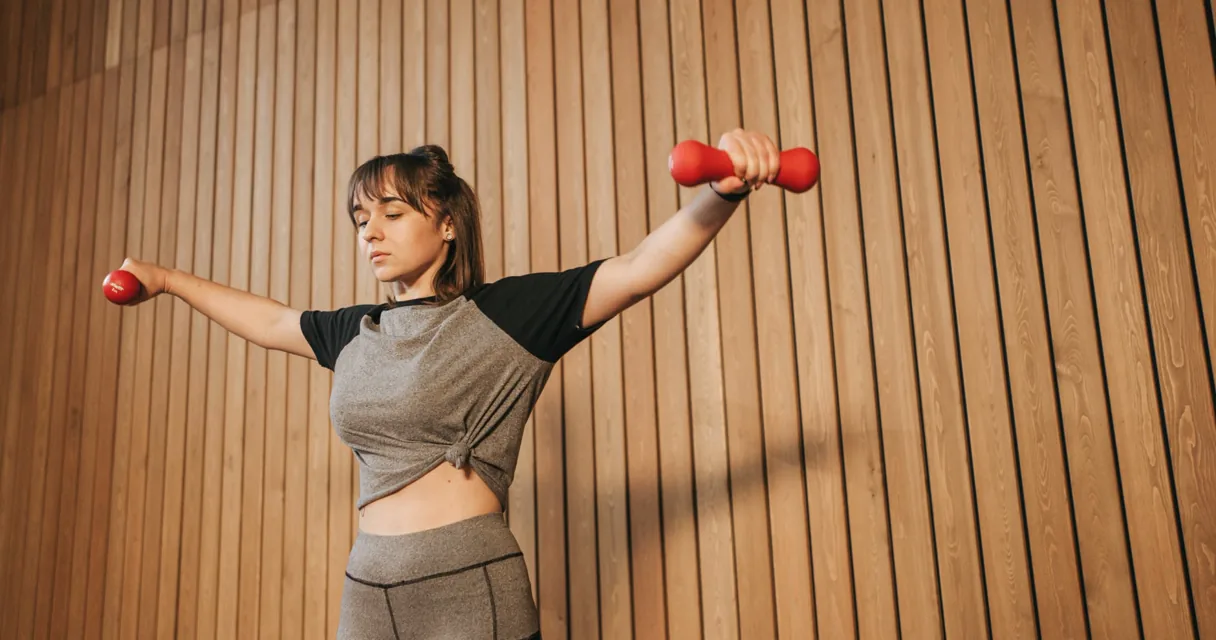
Cable versus dumbbell lateral raises is often framed as a simple question: constant tension or free weights? The more useful question is which variation lets you train the lateral deltoid hard, with a repeatable path, for enough weeks to see progress. Both can build the side delts that contribute to shoulder width.
Cables change where resistance feels hardest. Dumbbells are simple, portable, and easy to set up. That mechanical difference matters for comfort and exercise selection, but it does not automatically decide muscle growth. A 2025 within participant study found similar lateral delt growth from cable and dumbbell raises when range of motion was matched.
Short answer: choose the version you can progress without cheating
A cable lateral raise is a strong choice if you want resistance from the bottom of the movement, enjoy one arm at a time, or need a stable handhold to limit torso sway. Set the pulley low, stand side on, and raise the handle in a controlled arc.
A dumbbell lateral raise is a strong choice when you train at home, want fast setup, or can make small load increases with adjustable dumbbells. The load feels light near the thighs and hardest near shoulder height, so the top half needs deliberate control.
| Your situation | Useful first choice | Reason |
|---|---|---|
| Home gym with limited equipment | Dumbbells | Minimal setup and easy access |
| Cable stack with a comfortable handle | Cable | Tension begins earlier in the range |
| You swing dumbbells from the bottom | Cable with a handhold | The setup can reduce momentum |
| You need very small loading changes | Whichever has smaller jumps | Progress depends on repeatable increases |
| You enjoy both movements | Pick one for six weeks | A stable record makes progress clearer |
What the resistance profile changes
Dumbbells are hardest near shoulder height
With a dumbbell, gravity pulls straight down. The external lever arm is smallest when the arm is close to the body and grows as the arm moves outward. This is why the beginning of a standing dumbbell raise can feel easy while the top becomes demanding.
That does not make dumbbells ineffective at the bottom. The lateral delt still contracts to guide the movement, and the full repetition can be productive when you control it. It simply means that acceleration from the thighs can hide effort. Start calmly, avoid bouncing, and lower slowly enough that each repetition looks similar.
Cables load the lower part more directly
A low pulley can create meaningful resistance before the arm reaches shoulder height. This may suit lifters who prefer tension in the lengthened position or who find that dumbbells invite momentum. Cable stations also make unilateral work convenient: one hand can hold the tower while the other raises.
The common claim that cables are always superior because tension is constant goes too far. Constant tension is a mechanical description, not a guarantee of more hypertrophy. The 2025 study comparing the two variations with matched range of motion found no clear winner for lateral delt thickness. Use the profile that improves your execution rather than chasing a slogan.
Technique that keeps lateral raises on the side delts
Use a slightly forward arm path
Raise the arm slightly in front of the torso rather than forcing it directly out to the side. This scapular plane often feels more natural for the shoulder. Keep a soft elbow bend and let the elbow lead the hand. There is no need to turn the thumb dramatically down.
Stop around shoulder height or at the highest point you can reach without shrugging hard or losing control. A bigger range is only useful when your shoulder remains comfortable and your torso does not change position to create it.
Remove momentum before adding load
For dumbbells, stand tall, begin with the weights still, and use a controlled two to three second lowering phase. For cables, step far enough from the stack that the cable has tension at the bottom, but not so far that the handle pulls your torso toward the machine.
If every last repetition becomes a hip swing, lower the load or use a handhold. A lighter set that keeps the lateral delt loaded is more useful than a heavier set performed by the lower back and traps.
Programming cable and dumbbell lateral raises
Lateral raises are usually best treated as an accessory movement rather than a test of maximal strength. Start with two to four hard sets, two or three times per week, and keep most sets around one to three repetitions in reserve. A range of 10 to 20 repetitions works well when the final repetitions remain controlled.
| Goal | Variation | Sets and repetitions | Progression target |
|---|---|---|---|
| Learn the movement | Dumbbell or cable | 2 to 3 × 12 to 20 | Add repetitions first |
| Shoulder hypertrophy | Preferred stable option | 3 to 4 × 10 to 20 | Add a small load after reaching the top range |
| One side loses control | Single arm cable | 3 × 12 to 18 each side | Match the weaker side |
| Home training | Dumbbell | 3 × 15 to 25 | Add repetitions, slower lowering, then load |
Pair lateral raises with a main press and rear delt work instead of assuming presses cover every part of the shoulder. The shoulder exercise guide helps you build a balanced menu. If pressing is already demanding, the dumbbell versus barbell overhead press guide can help you choose a main movement that fits your setup.
Use the progressive overload guide to decide whether an extra repetition, a cleaner range, or a small load increase counts as progress. The RPE scale guide is useful when the same weight feels different after hard pressing.
Common mistakes
Raising far above a controlled range
More height is not automatically more lateral delt work. When the shoulders shrug aggressively or the torso tilts, the exercise changes. Use the range you can own, then build it gradually.
Switching variations every session
Cable and dumbbell raises can both work, but random rotation makes your training log difficult to interpret. Keep one primary option for at least four to six weeks before deciding whether it needs replacing.
Treating soreness as the scorecard
A new cable angle can make the delts sore without producing better long term progress. Track sets, repetitions, load, effort, and technique notes in GymLog. Your logbook gives a clearer answer than next day soreness.
Final verdict: cable and dumbbell raises both earn a place
Cables offer resistance earlier in the raise and can make unilateral execution stable. Dumbbells offer simplicity and a straightforward home training option. Neither is automatically best for side delt hypertrophy when hard sets and range of motion are comparable.
Choose the variation that you can perform with a stable torso, a comfortable shoulder path, and measurable progress. Download GymLog to record your lateral raises, shoulder volume, and RPE, then let several weeks of data guide your choice.