Incline Dumbbell Press for Upper Chest: Angle, Form, and Programming
2026-07-16
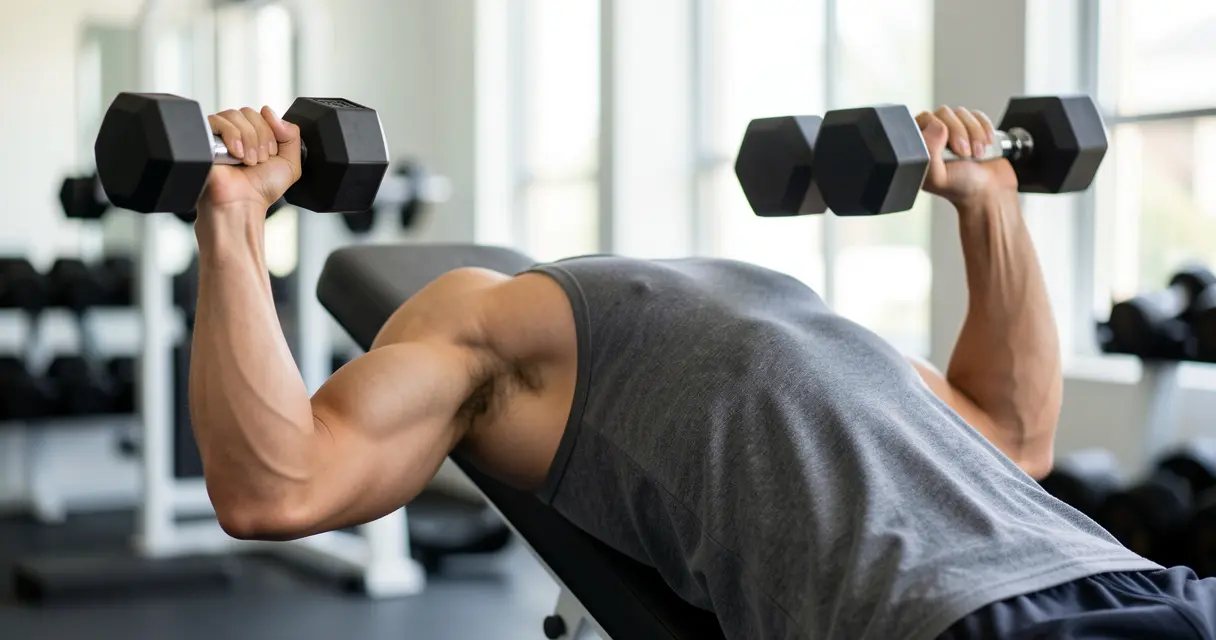
The incline dumbbell press is a strong upper chest exercise when the bench angle, range of motion, and loading all fit your body. It can also turn into a front shoulder exercise when the bench is too steep or the dumbbells drift into an unstable path. The fix is not a secret angle. It is a repeatable setup and an honest progression plan.
Dumbbells give each arm room to move through a natural pressing path. That can make the movement more comfortable than a barbell for some lifters, while exposing left to right differences that a bar can hide. It also demands more control, so chasing the same load as your flat press is rarely useful.
This guide explains how to set up the incline dumbbell press for upper chest hypertrophy, how to diagnose common mistakes, and how to program it without burying your shoulders or triceps in unnecessary volume.
What the incline dumbbell press can and cannot do
Your pectoralis major is a broad, fan shaped muscle. A slight incline changes the shoulder position and can bias the clavicular region, often called the upper chest. It does not isolate a separate muscle or replace all other chest pressing.
Research on barbell pressing angles gives useful context, but it should not be treated as a precise prescription for dumbbells. In a small 2021 EMG study, a 30 degree incline changed activation across regions of the chest compared with flat and decline variations. A separate eight week trial in untrained men found broadly similar general strength changes from flat, incline, or combined barbell bench press work, with one upper chest measurement favoring the incline group. These results support including an incline press when it fits your goal. They do not prove that one angle or exercise is mandatory for every chest.
The useful question is practical: can you feel and progressively load a comfortable pressing pattern through a meaningful range of motion? If yes, the incline dumbbell press deserves a place in your plan.
Set the bench before you pick the dumbbells
A low to moderate incline is usually the best starting point. Many adjustable benches place this around 15 to 30 degrees, although the numbered settings vary by brand. Very steep settings make the movement look more like a seated shoulder press and can shift more work to the front delts.
Use this simple angle test
Start at the lowest incline that is clearly above flat. Perform a controlled warm up set and ask three questions:
- Can you keep your shoulder blades set without your shoulders rolling forward?
- Do the dumbbells travel toward the upper to mid chest rather than your face?
- Can you feel chest tension near the bottom without pinching at the front of the shoulder?
If the answer is no, lower the bench one setting before changing five other variables. If a low angle feels stable and productive, you do not need to make it steeper just because another lifter uses a different setting.
Build a stable base
Plant both feet firmly and keep your hips on the bench. Slide your upper back into the pad, then gently pull your shoulder blades back and down. Think of keeping your chest proud rather than forcing an extreme arch. A small natural arch is normal; losing contact through your upper back is not.
Start with the dumbbells on your thighs. Use one controlled knee assist to bring them into position, then settle your shoulders before the first repetition. This matters more as the load rises. A rushed kick up is a common source of awkward shoulder positions.
Incline dumbbell press technique, step by step
Lower with control
Begin with the dumbbells above your upper to mid chest, wrists stacked over elbows. Use a grip that feels neutral to slightly pronated rather than forcing your hands into one fixed angle.
Lower the weights in a gentle arc toward the outer upper chest. Let the elbows travel roughly 30 to 60 degrees from your torso. Elbows pinned tightly to your sides often limit chest involvement, while elbows flared straight out can make the shoulder position less comfortable.
Descend until you reach a deep but pain free stretch. The dumbbells do not need to touch your chest. Long arms, deep benches, and mobile shoulders can all change where your safe bottom position sits.
Press up and slightly inward
Drive the dumbbells upward while keeping your upper back connected to the bench. Let the weights move slightly toward each other, but do not turn the top into a long squeeze that removes tension from the set. Finish with straight elbows if that is comfortable, then begin the next controlled descent.
Keep your wrists stacked over your forearms. If the wrists bend back, lower the load and reset. The goal is a smooth press, not a juggling act.
Use a repeatable tempo
A useful default is about two seconds down, a brief controlled stretch, then a purposeful press. Slow eccentrics are not magic, but they make it easier to own the bottom position. Read our tempo training guide before turning every set into an exhausting slow motion challenge.
Four errors that steal tension from the upper chest
The bench is too steep
A steep bench is not automatically wrong. It is simply more likely to become a shoulder press. Lower the angle if your front delts fail long before your chest or if the dumbbells finish high above your face.
The elbows flare without control
Some elbow flare is normal in a chest press. The problem is losing upper back position and letting the shoulders slide forward at the bottom. Reduce the load, keep the dumbbells in a manageable path, and rebuild control.
The range of motion is cut short
Half reps can be useful in a specific overloaded phase, but they are a poor default for hypertrophy. Use the deepest comfortable range you can control. If the bottom feels unstable, improve the setup or choose a lighter dumbbell before reducing range.
Every set is a maximal test
Dumbbells punish rushed failure reps. Most working sets should end with one to three repetitions in reserve. Use our RPE and RIR guide to learn how that target should feel instead of guessing from soreness alone.
How to program the exercise for hypertrophy
The incline dumbbell press can be your first chest exercise, a second press after flat benching, or a stable movement during a higher rep phase. The best placement depends on what you want to improve.
| Goal | Place in session | Sets and reps | Effort |
|---|---|---|---|
| Upper chest priority | First chest movement | 3 to 4 sets of 6 to 10 | 1 to 3 RIR |
| Balanced chest plan | Second chest movement | 2 to 3 sets of 8 to 12 | 1 to 3 RIR |
| Shoulder friendly phase | After machine or cable press | 2 to 3 sets of 10 to 15 | 2 to 3 RIR |
Start near the lower end of the set range if you already perform heavy flat pressing, flyes, and triceps work. More pressing only helps when you can recover from it and repeat it with good technique.
Use double progression
Pick a rep range, such as 8 to 12. Keep the same dumbbells until you can perform all planned sets at the upper end with your target RIR and a consistent range of motion. Then increase to the next available dumbbells and build back up.
For example, three sets with 26 kg dumbbells might look like 12, 11, and 10 reps at about two RIR. When you reach 12, 12, and 12 with the same control, move up. This is a simple application of progressive overload, not a reason to add weight every session.
Pair it with enough pulling
A chest focused plan still needs rows, pulldowns, and rear delt work. A strong upper back gives you a more stable pressing base and helps balance the total work around the shoulder. Keep direct triceps work proportional too; our triceps extensions guide can help you select accessories without turning a push day into twenty sets of elbow stress.
Dumbbells, barbell, or machine for upper chest?
There is no universal winner. Dumbbells are useful when you want each arm to work independently and you can control the bottom position. A barbell is useful when you want stable loading and clear performance data. A converging chest press machine is useful when free weights are uncomfortable or when you want to push closer to failure with less balancing demand.
You can rotate these tools across training blocks, but do not change exercises every week. Keep one main incline pattern long enough to learn it and measure progress. Our comparison of dumbbells, machines, and barbells can help you choose the right tool for your current goal.
The bottom line
The incline dumbbell press is an effective upper chest movement when it feels stable, reaches a controlled stretch, and progresses over time. Begin with a low to moderate incline, use a path that keeps your shoulders comfortable, and let clean repetitions determine the load.
Download GymLog to record bench setting, dumbbell load, reps, RIR, and notes from every press session. That record makes it easier to see whether a new angle actually improves your training rather than merely feeling different.