The Ultimate Guide to Triceps Extensions: Anatomy, Biomechanics, and Performance
2025-12-06
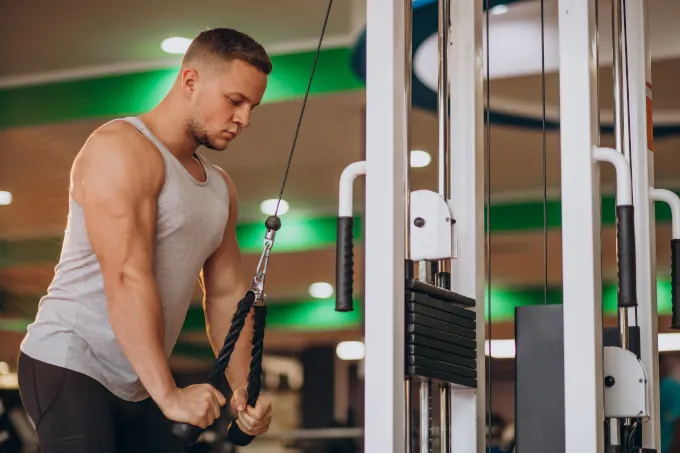
Achieving massive and powerful arms is a major goal for many bodybuilders. However, a persistent misconception often drives athletes to focus excessively on biceps. In reality, the triceps brachii make up about two-thirds of the muscle mass of the upper arm. Therefore, neglecting their development significantly limits your arm growth potential.
Triceps extensions, in their various forms, are the king isolation exercises for targeting this complex muscle group. Unlike compound movements like the bench press or dips, which also involve the chest and shoulders, extensions focus on the movement of the elbow joint, allowing for precise targeting.
I. Functional Anatomy and Biomechanics
To master triceps extensions, it is imperative to understand the muscle structure. The triceps brachii takes its name from Latin meaning "three-headed muscle". These three bundles (or heads) converge into a single tendon that attaches to the olecranon of the ulna (the elbow bone).
1. The Three Heads and Their Specifics
- The Lateral Head (Outer Head): Located on the outer face of the arm, this is what gives the characteristic "horseshoe" shape when well developed. It is particularly recruited during movements requiring explosive force and heavy loads.
- The Medial Head (Inner Head): Located deeper and often covered by the other two heads, it is essential for elbow stability and contributes to overall arm thickness at the elbow level. It is active in almost all elbow extension movements, regardless of shoulder position.
- The Long Head (The Key to Volume): This is the largest part of the triceps and the only one that is bi-articular. This means it crosses both the elbow and shoulder joints, attaching to the scapula (infraglenoid tubercle). This anatomical peculiarity is fundamental: the long head serves not only to extend the arm but also participates in shoulder extension and adduction (bringing the arm back and towards the body).
2. The Length-Tension Relationship and Shoulder Position
Understanding the bi-articular nature of the long head dictates exercise selection. According to the length-tension relationship principle, a muscle generates the most force and undergoes the greatest hypertrophy stimulus when worked in a stretched position.
- Stretched Position (Arms Overhead): When you raise your arm, the long head is stretched at its origin on the scapula. Performing a triceps extension in this position (Overhead Extension) places the long head under maximal tension, making it the "gold standard" for volume. Research shows that triceps hypertrophy is substantially greater after overhead extension training compared to a neutral position.
- Shortened Position (Arms Behind the Body): When the arm is in retroversion (as in a Kickback), the long head is in a shortened position. Although this allows for a strong contraction, the force production capacity is lower.
- Neutral Position (Arms by the Side): In exercises like pushdowns (cable extensions), the shoulder is in a neutral position. This mechanically disadvantages the long head and places most of the tension on the lateral and medial heads.
II. Technical Analysis of the Best Extension Variations
There is no single "best" extension, but rather different tools for different goals. Here is the detailed analysis of the essential variations.
A. Overhead Extensions
This is the priority exercise for the long head. It can be performed with a dumbbell (one or two hands), a barbell, a cable, or an elastic band.
- Execution: Standing or seated, raise the load overhead. Bend your elbows to lower the load behind your neck, seeking a deep stretch, then extend your arms towards the ceiling.
- Biomechanical Advantage: This variation maximizes the stretch of the long head, promoting stretch-mediated hypertrophy.
- Safety and Tips: It is crucial to keep elbows tucked and close to ears, without letting them flare out excessively, to maintain tension on the triceps and protect the shoulder. The seated version is often preferable as it reduces the need for core stabilization, allowing you to dedicate all nervous energy to the triceps.
B. Skull Crushers & Lying Extensions
Often confused, these two terms designate slightly different executions with distinct impacts.
- The Skull Crusher: The bar is lowered directly towards the forehead. It is an excellent mass builder targeting all three heads, with an emphasis on the lateral and medial. However, tension drops drastically at the top of the movement when arms are locked vertically (aligned with gravity).
- The Lying Extension (Behind the Head): Instead of stopping at the forehead, let the bar descend behind the head. This increases shoulder flexion.
- Why it’s superior: By going behind the head, you stretch the long head more. Additionally, this maintains constant tension even at the top of the movement because the arms are never perpendicular to the floor, preventing the muscle from resting.
- Recommended Equipment: Using an EZ bar is highly recommended over a straight bar. The angled grip of the EZ bar reduces torsional stress on wrists and elbows, allowing you to handle heavier loads with less risk of injury.
C. Cable Pushdowns
This is the most popular exercise, often done at the beginning or end of a session.
- Target: Primarily the lateral head (for the "horseshoe") and the medial head.
- Execution: Elbows locked against ribs, push the load down until full extension. It is imperative not to let elbows rise too high or flare away from the body to avoid engaging lats or shoulders.
- Grip Variations:
- Pronated Grip (Palms down): The standard version for lateral head strength and volume.
- Supinated Grip (Palms up): Often cited for targeting the medial head, but limits usable load as the grip is weaker.
- Rope: Allows for a greater range of motion by spreading hands at the bottom, increasing lateral head contraction.
D. Kickbacks
Often poorly executed with dumbbells, kickbacks place the triceps in a position of maximal contraction (arm extended behind the body).
- The Dumbbell Problem: With a dumbbell, the resistance curve is mediocre. There is no tension at the start of the movement (when the arm is at 90 degrees) and tension is maximal only at the very end.
- The Cable/Band Solution: It is biomechanically superior to perform kickbacks with a cable or band. These tools provide continuous or ascending tension that better matches the muscle’s force curve in this shortened position.
E. Other Exercise Variations
It is always good to vary angles and equipment. Here are other effective movements.
III. Equipment Strategy: Cables, Free Weights, or Bands?
The choice of tool modifies the resistance curve, i.e., at what point the exercise is most difficult.
1. Free Weights (Dumbbells and Barbells)
They are essential for progressive overload and building raw strength. However, they are slaves to gravity. For example, during a Skull Crusher, there is a "dead" point at the top of the movement where the triceps is no longer working. Dumbbells offer greater freedom of movement than the barbell, which can spare joints and correct muscle imbalances (unilateral work).
2. Cables (Pulleys)
Cables offer constant tension throughout the range. Unlike dumbbells, resistance does not depend on vertical gravity but on the axis of the cable. This is ideal for metabolic hypertrophy (the "pump") and keeping the muscle under tension longer (Time Under Tension).
- Expert Tip: For overhead extensions, cables are often superior to dumbbells because they maintain uniform tension even in the maximal stretch position, where the dumbbell can become unstable.
3. Elastic Bands (Accommodating Resistance)
Bands have a unique property: resistance increases as you stretch the band. This corresponds to the natural force curve of the triceps, which is stronger at full extension (lockout) than at the beginning.
- Application: Bands are excellent for finishing movements like pushdowns or kickbacks, where you seek maximal contraction. They are also a viable alternative for home training.
IV. Programming: How to Structure Training?
For massive triceps, doing sets of 10 repetitions at random is not enough. A structured approach is needed.
1. Exercise Order
It is generally advisable to start with heavy compound exercises (like close-grip bench press or dips) if you do them, as they demand the most energy and recruit the most muscle mass. Then, move on to heavy extensions (Skull Crushers/Overhead), and finish with continuous tension isolation exercises (Cables/Pushdowns).
2. Volume and Intensity (Force vs Hypertrophie)
Triceps muscle fibers respond well to a variety of stimuli.
- Strength: For pure strength, favor heavy loads (85%+ of 1RM) in the 1-5 repetition range. This mainly concerns compound movements or heavy barbell extensions.
- Hypertrophy (Volume): The ideal range is between 8 and 15 repetitions. This is the "sweet spot" for accumulating volume without excessively stressing elbow joints.
- Muscular Endurance: Sets of 20 to 30 repetitions can be used at the end of a session (finisher) with bands or cables to gorge the muscle with blood.
3. Training Frequency and Recovery
Triceps are indirectly stressed during all pushing sessions (chest, shoulders).
- Recovery: Allow 48 to 72 hours of rest for a muscle group before working it intensely again. If you train your triceps the day after a big chest session, they will already be fatigued, limiting performance and growth.
- Frequency: A frequency of 2 to 3 times per week is optimal for most natural athletes, spreading the volume (e.g., one heavy session and one light session).
V. Common Mistakes and Injury Prevention
Triceps extensions are notorious for causing elbow pain (tendonitis). Here is how to avoid it.
1. Elbow Flaring
The most frequent mistake. During extensions (especially lying or overhead), letting elbows flare out transfers the load from triceps to shoulders and joints.
- Correction: Keep elbows "tucked in", aligned with shoulders. Imagine trying to break a bar in half inwards.
2. Ego Lifting (Excessive Loads)
Using too heavy a weight forces the body to use momentum and other muscles to move the load. This reduces triceps activation and exponentially increases the risk of tear or tendonitis.
- Correction: Prioritize movement quality and Full Range of Motion over the weight on the bar.
3. Wrist Issues
Using a straight bar for extensions can force wrists into an unnatural position, causing pain.
- Correction: Systematically use an EZ bar or dumbbells (neutral grip) to respect natural wrist alignment.
4. Neglecting the Long Head
Many practitioners settle for doing Cable Pushdowns. However, as seen previously, this leaves the long head (the biggest part of the muscle) under-stimulated.
- Correction: Obligatorily integrate at least one exercise with the arm raised overhead into your routine.
VI. Example of Complete Triceps Routine
For complete development, a session must include an exercise for each mechanical function. Here is a proposal based on the discussed principles:
- Compound Movement (Heavy):
- Dips or Close-Grip Bench Press: 3 sets of 6-8 reps. (Targets overall mass and strength).
- Stretch Extension (Long Head):
- Seated Dumbbell Overhead Extension: 3 sets of 10-12 reps. (Maximizes long head volume).
- Contraction Extension (Lateral/Medial Heads):
- Rope Triceps Pushdown: 3 sets of 12-15 reps. (Focus on lateral head and final contraction).
- Finisher (Pump):
- Cable or Band Kickbacks: 2 sets of 15-20 reps unilateral. (Total isolation in shortened position).
Conclusion
Triceps extension is not just an accessory movement; it is a surgical tool for arm building. The key lies in intelligent variety: do not just push a bar down.
To unlock maximal growth, you must manipulate your shoulder position. If you want bigger arms, science and experience agree: integrate overhead extensions to stretch the long head, use lying extensions with an EZ bar for overall mass, and finish with cables for definition. By respecting biomechanics and avoiding ego lifting, you will transform your triceps into a major physical asset.
Want to track your progress and optimize your triceps workouts? Download the GymLog app now to log your sessions, analyze your performance, and reach your goals faster!