Resistance Bands for Bodybuilding: The Complete Guide
2025-11-25
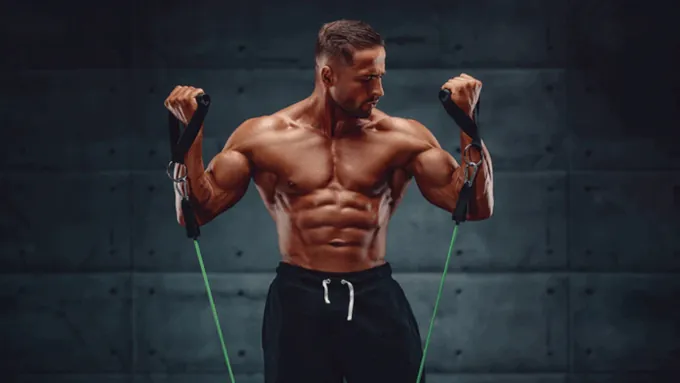
For years, I thought resistance bands were reserved for beginners or rehabilitation. Like many, I believed you absolutely had to lift iron to build muscle. Then I discovered what science had to say on the subject, and my view changed completely.
Today, whether you’re stuck at home, traveling, or simply looking for a gentler alternative for your joints, resistance bands deserve your attention. Let me explain why and how to use them effectively.
Why Resistance Bands Really Work for Building Muscle
Let’s start by breaking the myth: yes, you can actually build muscle with bands. It’s not marketing, it’s validated science. A major 2019 study compared training with bands and free weights. The result? Strength and muscle mass gains were practically identical.
Why? Because your muscle doesn’t know the difference between tension created by a dumbbell or a band. What matters is the mechanical tension itself.
The Secret of Progressive Resistance
Here’s where it gets really interesting. Unlike a dumbbell whose weight remains constant, a band offers progressive resistance. The more you stretch it, the more the tension increases.
Take a bicep curl for example:
- Start of movement: your arms are straight, you are mechanically weak, the band offers little resistance.
- End of movement: your biceps are contracted, you are strong, the band offers its maximum resistance.
This is exactly the opposite of a dumbbell, where the weight is hardest to handle at the start of the movement when you are most vulnerable. This natural adaptation to your strength curve makes the band a remarkably intelligent tool for protecting your joints while maximizing muscle tension where you need it.
Time Under Tension: Your Hypertrophy Ally
One of the most important factors for muscle growth is the time your muscle stays under tension. With a band, this tension is constant, continuous, without a rest phase.
Unlike free weights where you can "cheat" by using momentum or resting briefly at the top or bottom of the movement, the band forces you to maintain contraction from start to finish. Result: your muscles work longer, more intensely.
How to Choose Your Band: The Practical Guide
Not all bands are created equal. Here’s what you need to know before buying.
The Three Main Types
1. Super Bands (Power Loops) These are my favorites for serious bodybuilding. These large closed loops are incredibly versatile. You can use them for squats, deadlifts, hang them from a pull-up bar, or even combine them. Some can offer up to 50-80 kg of resistance. Perfect if you’re looking to really progress.
2. Tubes with Handles Excellent for reproducing cable movements found in gyms. The handles facilitate grip and allow varying angles (pronation, supination) to target different parts of the muscle. Ideal for pulling and pushing exercises.
3. Mini-Bands (Fabric Bands) These small fabric loops are fantastic for the lower body. Place them above your knees during squats to force glute activation. Unlike latex bands, they don’t roll or pinch the skin. However, their range is limited, so reserve them for specific exercises.
The Material War: Latex vs TPE
If I had to give you one piece of advice, it would be this: invest in natural latex. Yes, it’s more expensive upfront (about 20-40€/$ for a good band vs 10-15€/$ for TPE).
But here is the reality:
- Natural Latex: lasts 3-5 years with regular use, superior elasticity, resists tearing well.
- TPE (synthetic): lasts about 1 year, develops micro-cracks, higher risk of sudden snapping.
I’ve tested both. Believe me, the day a TPE band snaps in your face mid-exercise, you’ll understand that saving 15€/$ wasn’t worth it. Safety first.
Which Resistance to Choose?
Here is a simple guide based on your level:
- Beginner: Start with light resistance (5-10 kg, often yellow or red). The goal is to learn the movements correctly.
- Intermediate: Move to medium (15-25 kg, green or blue) once 15-20 repetitions become easy.
- Advanced: Aim for heavy (30-50 kg, black or purple) or combine multiple bands.
My advice: buy a kit of 3-4 different resistances. Some muscles are stronger than others, you will need to vary.
Essential Exercises for the Whole Body
Let’s get practical. Here are the essential movements that will allow you to build a complete physique.
Lower Body
The Band Squat Place the band under your feet, hold the other end at shoulder level. Descend into a classic squat. The maximum resistance at the end of the movement (when you come up) is perfect for thigh and glute development. Bonus: add a mini-band above the knees and push outward during the movement. Your glutes will burn like never before.
The Deadlift Same principle: band under the feet, pull upwards keeping your back straight. The huge advantage here is that resistance is minimal at the most dangerous moment (at the bottom, bent over) and maximal when you are standing (safe position). Your lower back will thank you.
Upper Body - Back and Biceps
The Row Hook your band to a fixed point (door handle, bar), step back to create tension, and pull towards you keeping elbows close to the body. It’s the king of exercises for a thick back and developed biceps. Variation: do it unilaterally (one arm at a time) to correct muscle imbalances.
The Bicep Curl Step on the band, grab the ends, and flex your elbows. Simple, effective, and the tension at the end of the movement is exactly what’s needed to pump your biceps.
Upper Body - Chest and Shoulders
The Band Chest Press Pass the band behind your back, hold the ends in your hands, and push in front of you (you can do this standing or lying on the floor). Progressive resistance means your pecs work hard exactly where they are strongest.
The Overhead Press Trap the band under your feet, grab it at shoulder level, and push overhead. Excellent for round and powerful shoulders.
Tricep Extensions Hook the band high up, turn your back to the anchor point, and push down keeping elbows fixed. Your triceps will explode.
The Little Extra: Band Pull Apart
This simple exercise is often neglected, but it is crucial. Hold the band in front of you at chest height, and pull it by spreading your arms outward. This strengthens the rear delts and back muscles, essential for good posture and injury prevention.
How to Progress: Progressive Overload Without Changing Bands
Here is the problem: the resistance gap between two bands is often too large. Jumping from 20 kg to 35 kg is huge. So how to progress smartly?
Strategy 1: Increase Repetitions
The simplest. Aim to add 1-2 repetitions per week. If you were doing 3 sets of 10, do 3 sets of 12, then 14, before changing the band.
Strategy 2: Shorten the Band
Grab the band closer to its anchor point, or spread your feet wider if you are stepping on it. Instantly, the starting tension increases.
Strategy 3: Stack the Bands
This is my favorite method. Instead of jumping from 30 kg to 45 kg, add a small 5-10 kg band to your main band. You create perfect intermediate steps for linear progression.
Strategy 4: Slow Down the Execution
Focus on the eccentric phase (the return). Take 3-5 seconds to return to the starting position. You drastically increase time under tension without changing equipment. It burns terribly, but it’s incredibly effective.
Programming for Hypertrophy: The Numbers That Matter
If you want to gain muscle, respect these principles:
- Repetitions: Aim for 8-12 repetitions per set for hypertrophy. If you can easily do 15 repetitions, the resistance is too low.
- Sets: 3-4 sets per exercise, with 60-90 seconds of rest between each.
- Frequency: Work each muscle group 2-3 times per week. For example: Monday (Upper Body), Wednesday (Lower Body), Friday (Full Body).
- RIR (Reps in Reserve): Stop 1-2 repetitions shy of muscle failure. You must feel that you could have done 1-2 more reps, but no more.
- Progression: Log your performance. Every week, try to add a repetition, reduce rest time by 5 seconds, or slightly increase tension.
Mistakes That Ruin Your Results
After coaching several people with bands, I’ve identified recurring mistakes:
Mistake 1: Not Maintaining Tension at Start Position
Many completely release tension between repetitions. Bad idea. Always keep slight tension, even at rest. This is what differentiates a good band exercise from a mediocre one.
Mistake 2: Pulling Too Fast
The band is not made to be pulled brutally. Control every phase of the movement. A tempo of 2 seconds up, 1 second pause, 3 seconds down is ideal.
Mistake 3: Over-Stretching the Band
Golden rule: never beyond 2 times resting length (maximum 4 times for ultra-resistant models). Beyond that, you create invisible micro-tears that will eventually cause a rupture. And believe me, a band snapping under tension is dangerous.
Mistake 4: Neglecting Inspection
Before each use, visually inspect your band. Look for micro-cuts, whitened areas, tears. If you see the slightest defect, throw the band away immediately. Your safety is priceless.
Maintenance: How to Make Your Bands Last
Here is the mistake almost everyone makes: cleaning their bands with unsuitable products.
What NEVER TO DO: use alcohol, disinfectants, or harsh chemicals. These substances destroy the molecular structure of latex, dry it out, and make it brittle.
The Right Method:
- Mix warm water with a few drops of mild dish soap.
- Clean the band with a soft cloth soaked in this solution.
- Rinse with clear water.
- Air dry, NEVER in direct sunlight (UV degrades latex).
- Once dry, lightly sprinkle with talc to prevent them from sticking together.
Storage: Store your bands in a cool, dry place, away from light. A drawer or opaque gym bag is perfect. Follow these tips, and your natural latex bands will easily last 3-5 years, even with daily use.
The Hidden Bonus: Stability and Core Strength
There is a benefit of bands that is little discussed but absolutely fundamental: three-dimensional instability. Unlike a dumbbell that simply pulls downwards (gravity), a band pulls in the direction it is anchored, creating changing forces that your body must constantly compensate for.
Result: your stabilizer muscles and core work constantly, even during a simple bicep curl. Every exercise becomes, in a way, a core exercise. You don’t just build muscle, you build a functional, stable body resistant to injury. It’s this quality that makes band training so transferable to sports and daily life.
Bands vs Dumbbells: The Final Verdict
So, do you have to choose? The truth is, both have their place.
Dumbbells allow precise load measurement and are essential if you aim for powerlifting competition. Bands offer incomparable flexibility, superior joint safety, and similar results for hypertrophy.
My approach: use bands as the base of your home training, and supplement with dumbbells if you have access to a gym. The best of both worlds.
Conclusion: To Start Today
If I had to give you a simple action plan to start with bands, here it is:
- Buy a quality kit: 3-4 natural latex bands of different resistances.
- Start light: Even if you are used to weights, take the time to learn movements with moderate resistance.
- Simple program: 3 sessions per week, 4-5 exercises per session, 3 sets of 10-12 repetitions.
- Progress slowly: Add a repetition per week, or slightly shorten the band every 10 days.
- Be patient: The first visible gains appear after 6-8 weeks.
Resistance bands have completely changed the way I train. They allowed me to stay consistent even while traveling and protect my joints. Science confirms it: with the right approach, you can build as much muscle with bands as with dumbbells.
So, what are you waiting for? A resistance band, a solid anchor point, and your motivation—that’s all you need to start transforming your physique.
To go further and track your progress, download the GymLog app which will allow you to log your sessions and visualize your evolution.